

Adherence to biosafety and biosecurity protocols: An assessment of biomedical and veterinary laboratories in Benin

LOCATION OF LABORATORIES SURVEYED IN BENIN, 2023.
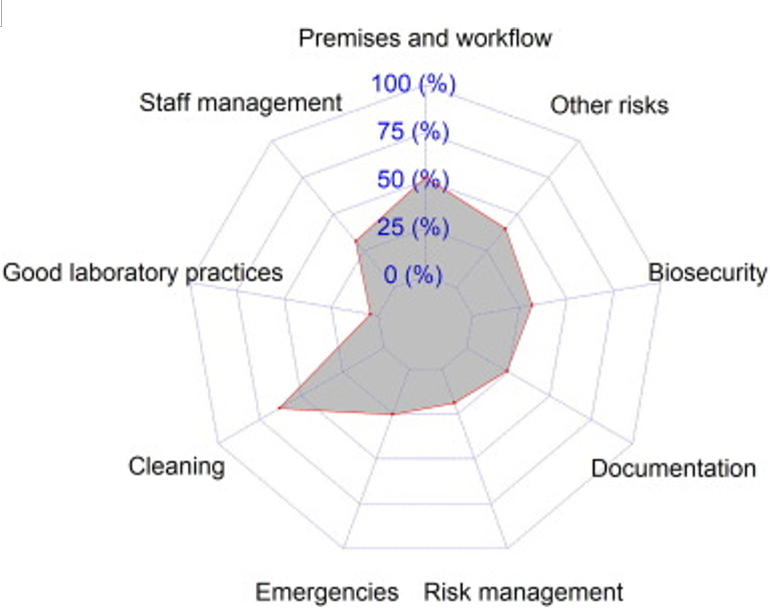
DISTRIBUTION OF AVERAGE SCORES BY MODULE DURING THE ASSESSMENT OF BIOMEDICAL LABORATORIES IN BENIN, 2023.
GA, UNITED STATES, June 16, 2026 /EINPresswire.com/ -- Diagnostic laboratories are central to disease surveillance and epidemic preparedness, yet poor adherence to biosafety and biosecurity protocols can put laboratory staff, communities and the environment at risk. This study assessed biosecurity and biosafety practices in 96 public and private biomedical and veterinary laboratories in Benin. Using a cross-sectional design, biomedical laboratories were evaluated with the Biosafety and Biosecurity in Laboratory Tool, while veterinary laboratories were assessed using the Laboratory Mapping Tool. Data were collected through KoBoCollect and analysed using R. Most laboratories showed poor compliance with established guidelines: 42% were classified as very high risk, 38% as high risk, 15% as moderate risk and only 5% as low risk. Strengthened policies and targeted capacity-building for laboratory staff and managers are urgently needed.
Constrained by insufficient funding and incomplete regulatory frameworks, most African nations suffer poor biosafety systems. In particular, Benin scored merely 25.4% in the 2021 Global Health Security Index, lacking official biosafety evaluation benchmarks, which necessitated this field investigation.
Funded by the U.S. Department of State, a cross-sectional survey assessed 96 laboratories across Benin in November 2023, including 93 biomedical and three veterinary facilities. The researchers adopted the BSSLAT and FAO’s LMT assessment tools respectively, collected data via KoBoCollect and performed statistical analysis using R software.
“The overall biosafety risk was alarming: 42% of surveyed labs fell under very high risk, 38% high risk, 15% moderate risk and only 5% low risk,” says the study’s corresponding author, Philippe Sessou.
In particular, 80% of biomedical laboratories and all veterinary ones were categorized as high-risk sites. These labs routinely store hazardous pathogens ranging from malaria parasites, hepatitis viruses and tuberculosis bacilli to Ebola and Lassa viruses, yet inadequate facilities and flawed management fail effective pathogen containment.
The team of researchers found only two assessment modules of biomedical labs (premise layout and disinfection/waste disposal) met international standards. “Severe deficiencies existed in staff training, standard experimental practices, emergency preparation and biosecurity management,” says Sessou. “Most labs had no dedicated biosafety officers or standardized operating manuals, with shortages of biosafety cabinets, emergency eyewash stations and designated handwashing sinks.”
Loopholes were also found in pathogen registration, access control and digital data protection. All three veterinary laboratories failed compliance checks; though basic access restriction was enforced, they suffered from uninspected key equipment, insufficient emergency supplies and improper waste disposal.
“Consistent with related research in African settings, Benin’s poor biosafety status stems from outdated infrastructure, insufficient staff training, incomplete national regulations and chronic financial shortage,” adds Sessou.
The team’s recommendations include enacting localized biosafety codes and regular tiered training for practitioners. “The Beninese government ought to boost financial input to renovate lab infrastructure, supplement safety equipment and recruit full-time biosafety specialists,” urges Sessou. “In addition, international exchanges can help introduce mature biosafety governance experience.”
The study's findings(DOI: https://doi.org/10.1016/j.jobb.2024.11.001) are published in the Journal of Biosafety and Biosecurity.
DOI
10.1016/j.jobb.2024.11.001
Original Source URL
https://doi.org/10.1016/j.jobb.2024.11.001
Funding information
This research was supported by the Elizabeth R. Griffin Program through funding provided by the U.S. Department of State, Nonproliferation and Disarmament Fund (grant number SISNDF22GR0010). The funders had no role in study design, data collection and analysis, decision to publish, or preparation of the manuscript.
Lucy Wang
BioDesign Research
email us here
Legal Disclaimer:
EIN Presswire provides this news content "as is" without warranty of any kind. We do not accept any responsibility or liability for the accuracy, content, images, videos, licenses, completeness, legality, or reliability of the information contained in this article. If you have any complaints or copyright issues related to this article, kindly contact the author above.
